Product Specifications: Less than 2 grams; Product composition: ground coffee (10%) and freeze-dried coffee (90%); Packing size: 25mm*90mm; Residual oxygen: less than 1%; Packaging difficulties: There are obvious differences in the bulk density, fluidity, particle strength and hygroscopicity of the two materials. It is necessary to stabilize the feeding and independent measurement, and coordinate the blanking timing within the limited bag width. Solution: Fully consider the characteristics of the two materials, shorten the height of the runner as much as possible, and shorten the filling path of the ground coffee as small as possible, design an independent airflow circuit, and scrub through the blanking of freeze-dried coffee to reduce the adsorption of the inner wall of the grinding tube of the ground coffee. Based on the core Stick packaging technology provided by Joyea, DOT integrates dual filling, formula management, nitrogen filling, check weight feedback and data traceability into a verifiable packaging system.
C01 · PACKAGING ENGINEERING NOTE
Stick packaging system for coffee double micrometering: independent metering of ground coffee and freeze-dried coffee, synchronous into bags, formula management and quality control
Put the ground coffee and freeze-dried coffee into the same STIK in the set ratio, not just add a set of filling devices.
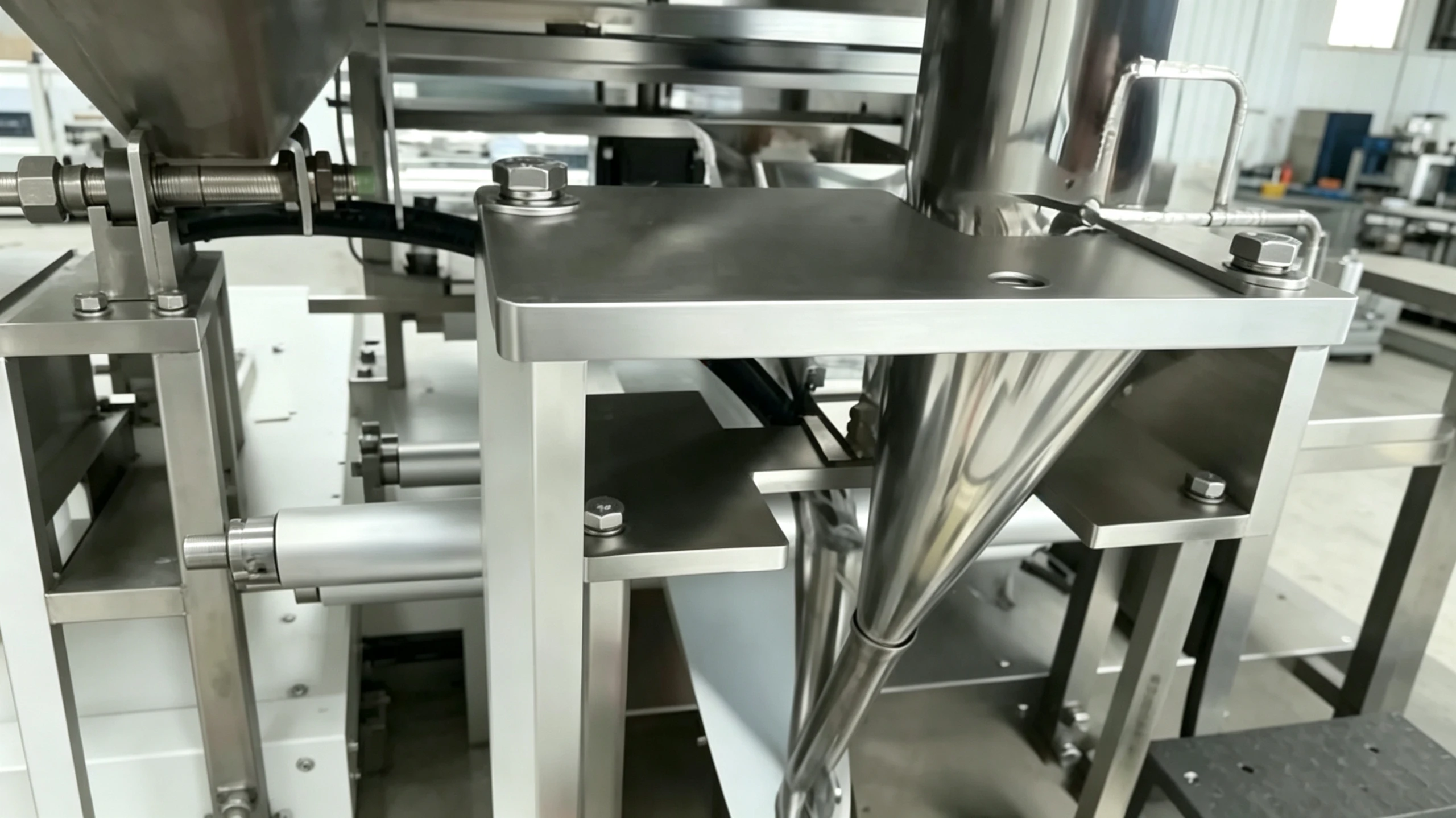
Why the Ingredients Require Independent Dosing
Ground coffee may bridge, generate dust, and change its feeding behavior as particle size or moisture varies. Freeze-dried coffee is comparatively fragile and can be damaged by compression, long drops, or aggressive agitation. Using one dosing mechanism for both materials can therefore compromise ratio stability and product appearance. A more robust concept provides separate product buffers, level control, and dosing modules selected for each ingredient. The two measured portions are then discharged into the same open stick according to a coordinated timing sequence, preserving recipe flexibility without treating fundamentally different materials as if they behaved alike.
System Architecture for Dual Micro-Dosing
The concept uses two independently controlled servo dosing units. The ground-coffee side prioritizes consistent material conditioning, dust containment, and repeatable micro-dosing. The freeze-dried side prioritizes gentle handling, a short drop path, and minimal particle compression. Their discharge paths converge above the forming area while remaining mechanically separable for inspection and cleaning. The recipe stores the target for each ingredient, dosing phase, refill logic, and material-shortage alarms independently. This architecture allows flavor ratios to change through controlled recipe parameters while limiting manual mechanical adjustment during product changeover.
From Recipe Control to Weight Feedback
A correct total stick weight does not by itself prove that the two ingredients are present in the correct ratio. The system should therefore monitor the operating status, refill condition, and dosing behavior of each metering unit separately, while using downstream checkweighing to verify the overall weight trend. Closed-loop corrections should follow defined permissions, adjustment limits, and maximum rates of change rather than reacting to every isolated reading. Recipe versions, alarms, manual interventions, and batch records should be retained so that deviations can be investigated and process settings can be improved using traceable production evidence.
Product Trials Define the Final Configuration
The final dosing technology must be selected through trials with representative coffee materials. Testing should include expected variations in bulk density, moisture, particle-size distribution, flowability, and the mechanical strength of freeze-dried granules. Evaluation should extend beyond dosing repeatability to include seal-area contamination, trapped product, dust migration, particle integrity, cleanability, and changeover time. DOT Engineering translates these findings into a line concept, while JOYEA provides the core stick-pack platform and key packaging equipment. The resulting specification can then define measurable acceptance criteria for the agreed products, pack formats, and operating conditions.
START WITH MATERIALS AND TARGETS