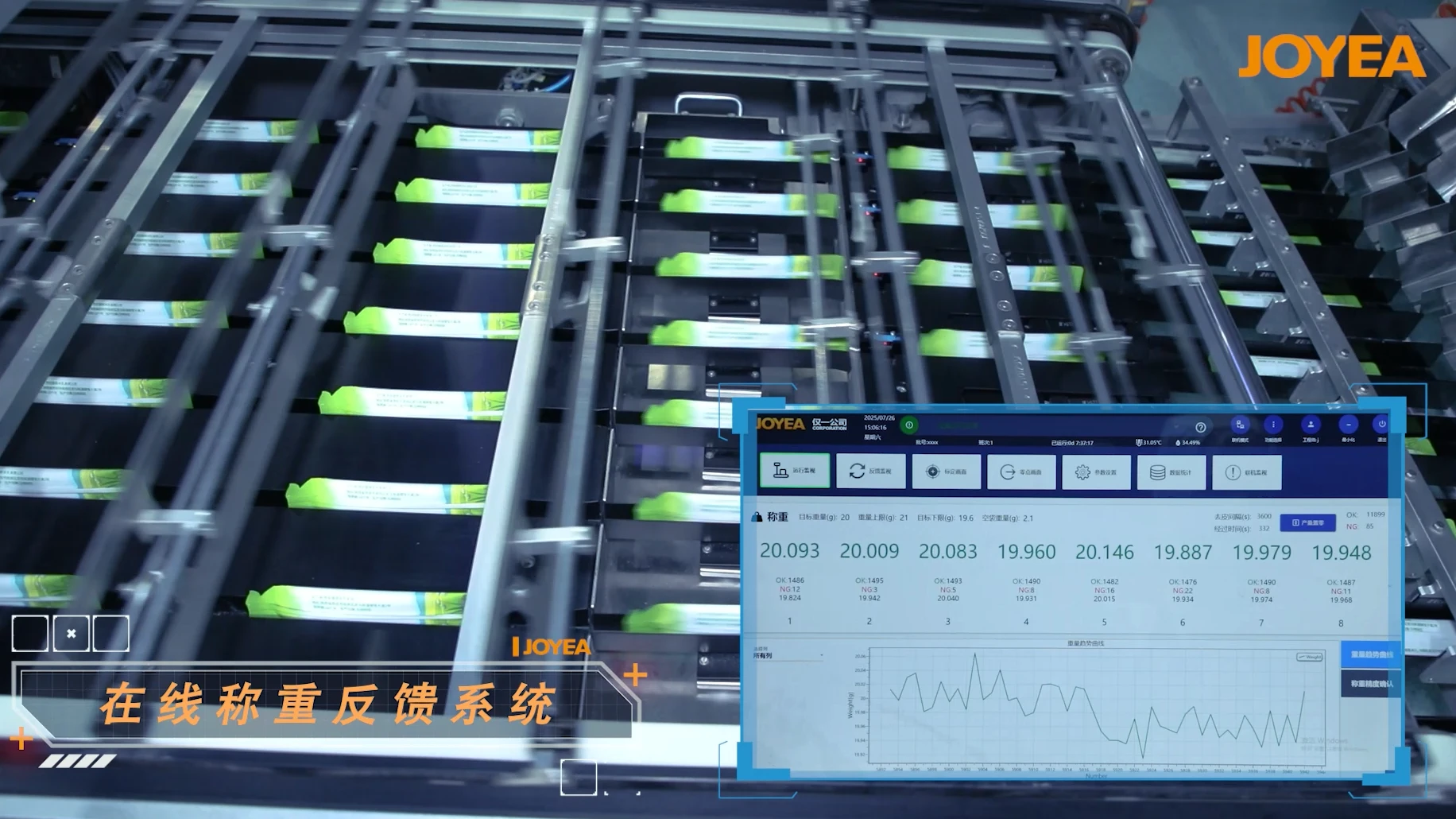
The multi-column STIC packer usually judges the operating status by the total average weight, but the average value may mask the problem of persistently high or low individual channels. For example, when one column is more installed and the other column is less installed, the average weight of the whole machine may still be in the qualified range, and the actual product has already experienced a risk of net content deviation, raw material waste and customer complaints. Therefore, the weight control must go from "the average of the whole machine" to "recognition by column". The checking weight system needs to accurately identify the measurement channel to which each Stick belongs at the outlet of the packaging machine, and associate the weight data with the corresponding channel, production time, product formula and equipment batch. The system should not be adjusted immediately according to a single accidental weight value, but should be filtered by moving average, trend judgment and outlier value, distinguishing random fluctuations from continuous deviation, and avoiding frequent compensation and causing oscillation of measurement mechanisms back and forth. When a stable deviation occurs in a channel, the control system can send correction instructions to the corresponding screw servo, measuring cup servo or other measuring mechanism within the setting authority, compensation upper limit and change rate. After the compensation is completed, the subsequent weight results need to be verified and adjusted again to form a closed-loop control of "detection-judgment-compensation-review". For products that exceed the upper and lower limits, the system should also complete independent removal, and confirm whether the culling action is successful through the sensor. If there is a continuous overdifference, the removal of failures, or the compensation has reached the boundary, the alarm should be triggered, the relevant channel or the whole machine should be triggered to prevent the unqualified products from entering the back channel packaging. DOT is based on the JOYEA multi-column Stick packaging platform, which integrates channel identification, statistical filtering, servo compensation, culling confirmation and batch traceability into the The verified quality control system enables each column to have independent weight evidence, which provides a data basis for reducing raw material loss, stable net content and continuous process optimization.
C03 · PACKAGING ENGINEERING NOTE
Multi-column STIC check-in closed-loop system: engineering design of weight feedback, servo compensation, non-conforming elimination and production data traceability
The total average weight of the multi-column STICK packaging machine may be normal, but a certain column may continue to be high or low. The column check weight can associate each package with the corresponding metering channel, and feed the stable trend to the screw servo or the metering box servo, and at the same time, independently eliminate the out-of-difference product. DOT is based on the JOYEA multi-column packaging technology, which integrates channel identification, statistical filtering, compensation boundaries, culling confirmation and batch traceability into a controlled closed loop, avoiding over-adjustment with a single fluctuation.
Why the Overall Average Can Hide Problems
If several lanes run heavy while others run light, the combined average may remain close to target even though giveaway and underweight risk exist at the same time. A lane-by-lane system must preserve pack identity from cutting through transfer and weighing, including any pitch change or lane convergence. The control system needs a reliable relationship between each stick, its originating lane, and the associated dosing actuator. Without that mapping, feedback can correct the wrong channel, and rejected packs cannot be traced to the responsible dosing path. Channel identity is therefore a core machine-design requirement, not merely a reporting feature.
Control the Trend Instead of Chasing Every Pack
Powders and granules naturally vary, and the checkweigher is also influenced by vibration, belt spacing, transfer stability, and air movement. The feedback algorithm should use a qualified sample window, trend rules, a deadband, and a minimum interval between corrections. Only persistent deviation should trigger a small adjustment. An auger system may alter servo rotation or related dosing parameters, while a volumetric-cup system adjusts the relevant servo-controlled volume according to its mechanism. Every correction must remain within approved limits, with larger deviations generating an alarm or intervention request rather than unrestricted automatic compensation.
A Reject Command Must Be Verified
Detecting an incorrect weight does not prove that the affected pack has been removed from production. The controller should track the stick from the weighing position to the reject point, issue the reject command at the correct time, and verify that the pack entered a secured reject container. Abnormal pitch, an unconfirmed reject stroke, a full container, or a tracking inconsistency should initiate a defined alarm or stop response. This verified-reject chain prevents an out-of-tolerance stick from continuing into bundling, bagging, cartoning, or case packing merely because a software reject flag was generated.
Traceability Should Support Process Improvement
For each lane, the system should retain suitable statistics such as average weight, dispersion, out-of-tolerance events, feedback adjustments, alarms, and operator interventions by recipe and batch. Trend views help teams distinguish material-condition changes, unstable refilling, dosing-component wear, and lane-specific mechanical faults. DOT Engineering uses checkweigher data as diagnostic evidence rather than decorative reporting. Together with the customer, the project should define valid-sample rules, access permissions, audit expectations, data retention, and acceptance testing. Regulatory and commercial tolerances remain customer- and market-specific and must be confirmed during project definition.
START WITH MATERIALS AND TARGETS